
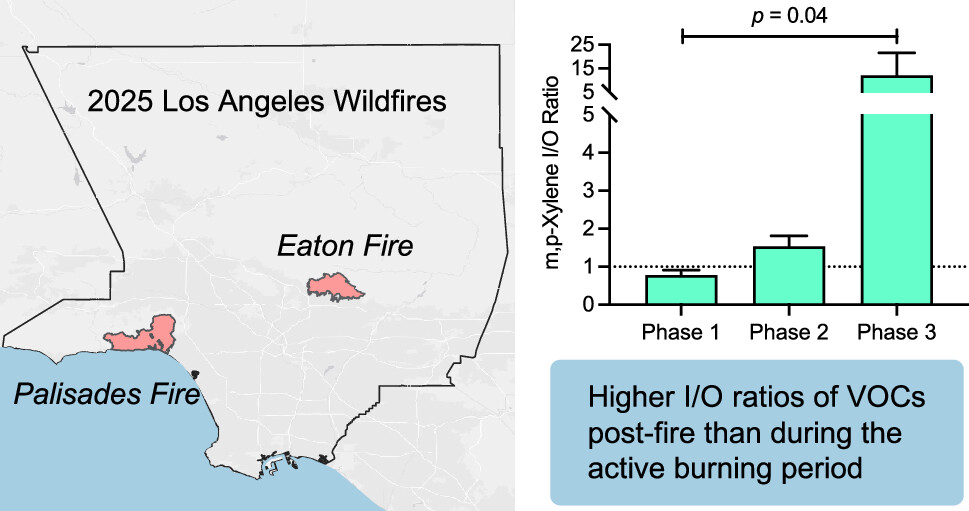
A new paper in the journal, Environmental Science & Technology Letters, by LA Fire HEALTH Study researchers Dr. Mike Jerrett and Dr. Yifang Zhu and their colleagues at UCLA Fielding School of Public Health shares levels of VOCs in air samples collected during and immediately following the January 2025 LA wildfires. These findings were also presented in the LA Fire HEALTH Data Brief on April 4, 2025 and Data Brief 8 on May 27, 2026.
Abstract
The January 2025 Los Angeles wildfires released large amounts of air pollutants and exposed millions of residents to smoke containing hazardous volatile organic compounds (VOCs). To assess exposure risks, we conducted indoor and outdoor VOCs sampling at 22 households near the Palisades and Eaton Fires across three phases: active burning with less than 50% containment (January 8–15), active burning period with more than 50% containment (January 24–31), and postfire (February 11–18). Outdoor benzene concentrations peaked during Phase 1, with a median (interquartile range) of 0.38 (0.27) ppb, decreased over time, and remained below the California Office of Environmental Health Hazard Assessment health benchmarks. Compared with the active burning period, indoor-to-outdoor ratios of m,p-xylene (p = 0.004), carbon tetrachloride (p = 0.002), and heptane (p = 0.02) were significantly higher in the postfire period. Elevated VOC levels were particularly evident in uninhabited homes within burn zones, suggesting ongoing indoor emissions from smoke-impacted materials. These findings raise concerns about indoor air quality postwildfire and the potential for prolonged exposure, underscoring the need for targeted mitigation and ongoing monitoring to protect public health during recovery.
Access the full article online.