
A new paper published in Environmental Science & Technology Letters from Dr. Yifang Zhu and her team at UCLA Fielding School of Public Health examines the fine particle matter (PM) pollution in the air after the LA wildfires. This is a follow-up to the data shared in Data Brief 1.
Abstract
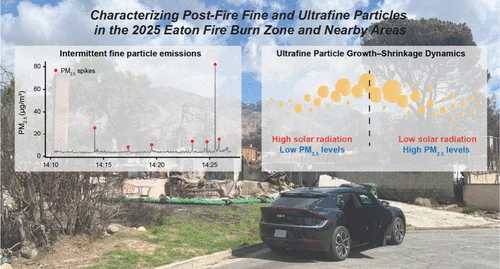
Particle emissions may persist in wildland–urban interface (WUI) fire burn zones during the postfire period, yet their characteristics remain poorly understood. Following full containment of the 2025 Eaton Fire, we conducted aerosol measurements to characterize the spatial variability and temporal dynamics of fine and ultrafine particles within and around the burn zone. We found that the burn zone (inside the fire perimeter) exhibited slightly lower median PM2.5 concentrations than locations >1000 m outside the perimeter (11.1 vs 12.0 μg/m3) but more frequent transient PM2.5 concentration peaks (2.8 vs 2.2 peaks/km) with greater prominence (9.0 vs 6.0 μg/m3) and shorter durations (2.9 vs 7.5 s). These results indicate intermittent and intense PM2.5 emissions that were not captured by time-integrated measurements. In addition, particle number concentrations within the burn zone were higher than the urban background measured ∼23 km downwind (1.2 × 10⁴ vs 9.5 × 10³ particles/cm3). Distinct aerosol dynamics were observed within the burn zone that may contribute to elevated particle number concentrations, including (1) formation and growth of ultrafine particles and (2) shrinkage and disintegration of submicron particles. Together, these observations demonstrate that the postfire period represents an active and evolving phase of WUI particle emissions with important implications for human exposure and health.