
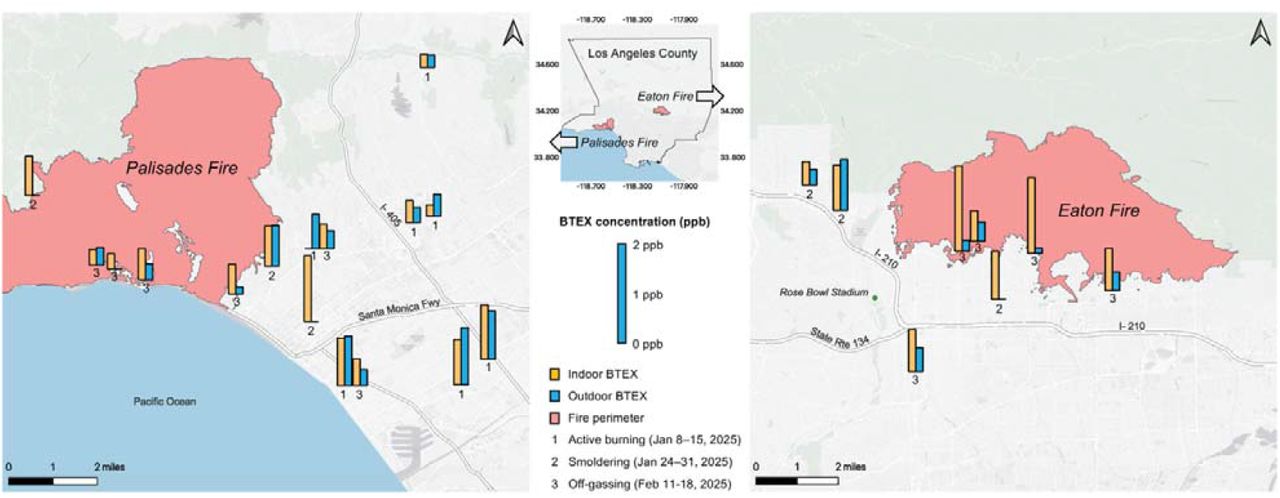
A preprint* of a new article by LA Fire HEALTH Study researchers Dr. Mike Jerrett and Dr. Yifang Zhu and colleagues shares air quality data collected during and immediately following the January 2025 LA wildfires. These findings were also presented in the LA Fire HEALTH Data Brief on April 4, 2025.
Abstract
The January 2025 Los Angeles urban wildfires caused extensive destruction and exposed millions to wildfire smoke containing hazardous volatile organic compounds (VOCs). To evaluate exposure risks, we conducted indoor and outdoor VOC sampling at 24 locations during three phases: active burning, smoldering, and off-gassing. Outdoor benzene concentrations peaked during active burning but remained below OEHHA health thresholds. In contrast, indoor BTEX concentrations increased during smoldering and remained elevated during the off-gassing phase, particularly in uninhabited homes inside burn zones, suggesting persistent emissions from smoke-impacted materials. These findings raise concerns about indoor air quality post-wildfire and the potential for prolonged exposure. We recommend ventilating homes and using HEPA and activated charcoal air purifiers before reoccupying fire-affected residences. Our results highlight the need for targeted mitigation and ongoing monitoring to protect public health during wildfire recovery.
*Before formal publication in a scholarly journal, scientific and medical articles are traditionally certified by “peer review.” In this process, the journal’s editors take advice from various experts—called “referees”—who have assessed the paper and may identify weaknesses in its assumptions, methods, and conclusions. Typically, a journal will only publish an article once the editors are satisfied that the authors have addressed referees’ concerns and that the data presented support the conclusions drawn in the paper. Because this process can be lengthy, authors use the medRxiv service to make their manuscripts available as “preprints” before certification by peer review, allowing other scientists to see, discuss, and comment on the findings immediately. Readers should therefore be aware that articles on medRxiv have not been finalized by authors, might contain errors, and report information that has not yet been accepted or endorsed in any way by the scientific or medical community. We also urge journalists and other individuals who report on medical research to the general public to consider this when discussing work that appears on medRxiv preprints and emphasize it has yet to be evaluated by the medical community and the information presented may be erroneous. Learn more.